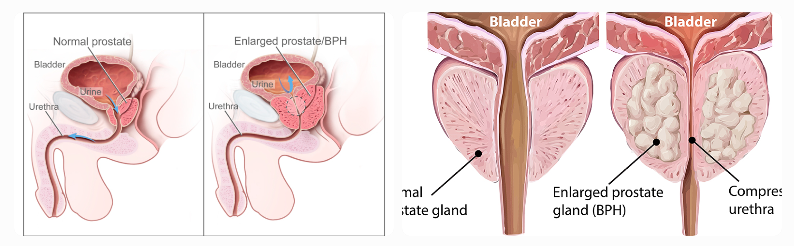
Enlarged Prostate (also known as Benign Prostatic Hyperplasia or BPH) is a common non-cancerous condition in older men where the prostate gland grows larger and presses on the urethra. This makes it difficult for urine to pass freely. It is not cancer and does not increase the risk of prostate cancer, but it can affect quality of life. In homeopathy, remedies are used only as supportive care to help improve urine flow, reduce urgency, and ease discomfort. Enlarged prostate requires proper medical evaluation by a urologist.
![Figure, Normal prostate and benign prostatic...] - PDQ Cancer Information Summaries - NCBI Bookshelf](https://www.ncbi.nlm.nih.gov/books/NBK65819.1/bin/CDR0000462221.jpg)
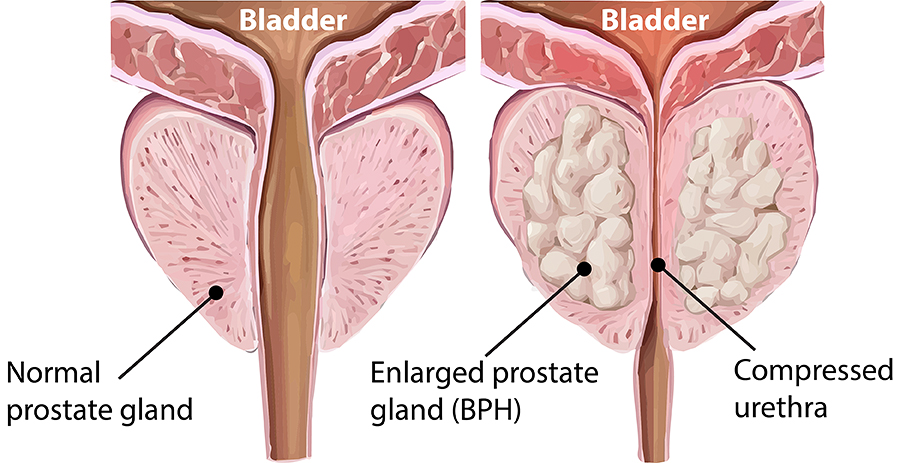
(Images above show enlarged prostate — comparison of normal prostate vs. enlarged prostate/BPH pressing on the urethra, causing urinary obstruction.)
Causes
Enlarged prostate is mainly caused by:
- Age-related hormonal changes (increase in dihydrotestosterone)
- Family history and genetic factors
- Hormonal imbalance (estrogen-testosterone ratio)
- Obesity, diabetes, and lack of physical activity
- Inflammation or other unknown factors
Symptoms
Common symptoms include:
- Frequent need to urinate, especially at night (nocturia)
- Difficulty starting urination or weak urine stream
- Dribbling at the end of urination
- Feeling of incomplete bladder emptying
- Sudden urgency to urinate or interrupted flow
- In severe cases: urinary retention or infections
Homeopathy Medicines with Key Symptoms and Doses
Homeopathic remedies for enlarged prostate are highly individualized based on urine symptoms, age, and overall constitution. They are used only as supportive care alongside lifestyle changes and medical monitoring. The following are commonly considered. Remedy selection must be determined only by a qualified homeopath after detailed case-taking, in coordination with a urologist. These are general guidelines only.
Sabal Serrulata For frequent urination at night with difficulty starting flow and feeling of fullness in the bladder. Typical use: 30C, 3-5 pellets 1-2 times daily.
Conium Maculatum For weak urine flow with dribbling and sensation of urine stopping and starting. Typical use: 30C, 3-5 pellets 1-2 times daily.
Lycopodium Clavatum For right-sided symptoms, frequent urging with weak stream, and digestive bloating. Typical use: 30C or 200C, 3-5 pellets 1-2 times daily.
Baryta Carbonica For elderly men with slow, weak stream and enlarged prostate with memory weakness. Typical use: 30C, 3-5 pellets 1-2 times daily.
Chimaphila Umbellata For difficult urination with mucoid sediment and sensation of a ball in the perineum. Typical use: 30C, 3-5 pellets 1-2 times daily.
Digitalis Purpurea For frequent urging with scanty urine and cardiac symptoms or slow pulse. Typical use: 30C, 3-5 pellets 1-2 times daily (short term).
Thuja Occidentalis For prostate enlargement with burning or stinging during urination and history of suppressed infections. Typical use: 30C, 3-5 pellets 1-2 times daily.
Pulsatilla For changeable symptoms with mild, weepy disposition and better in open air. Typical use: 30C, 3-5 pellets 1-2 times daily.
Silicea For slow, difficult urination with cold sensation and delicate constitution. Typical use: 6X or 30C, 3-5 pellets 1-2 times daily.
Calcarea Carbonica For sluggish, fair, and sweaty persons with prostate enlargement and constitutional chilliness. Typical use: 30C or 200C, 3-5 pellets once or twice weekly.
Important guidance: Enlarged prostate is diagnosed by digital rectal examination, PSA test, ultrasound, and uroflowmetry. Conventional management includes lifestyle changes (reduce caffeine/alcohol, limit fluids at night), medications (alpha-blockers, 5-alpha reductase inhibitors), or surgery in severe cases. Homeopathy may help improve urinary symptoms and comfort as supportive care but must never replace urological evaluation. Regular monitoring is essential to rule out complications like urinary retention or infection. This information is for educational purposes only and not a substitute for professional medical or homeopathic advice. Consult a qualified urologist for any urinary difficulties in men over 50, and a registered homeopath for individualized supportive remedy selection. With proper care, symptoms of enlarged prostate can often be well managed.