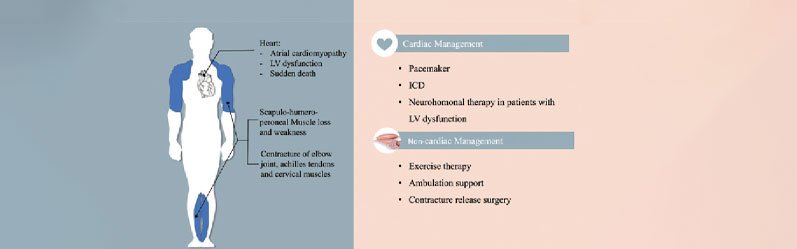
Emery-Dreifuss Muscular Dystrophy (EDMD) is a rare, slowly progressive genetic disorder that affects skeletal muscles and the heart. It belongs to a group called laminopathies or nuclear envelopathies. The condition is characterized by a classic triad: early joint contractures, progressive muscle weakness and wasting (especially in a humeroperoneal distribution — shoulders, upper arms, and lower legs), and cardiac involvement (conduction defects or cardiomyopathy). In homeopathy, remedies are used only as supportive care to help manage muscle weakness, joint stiffness, pain, fatigue, and associated symptoms while supporting overall vitality. EDMD has no cure and requires regular cardiac monitoring and multidisciplinary care.
(Images above show Emery-Dreifuss Muscular Dystrophy — clinical features including muscle wasting in humeroperoneal regions, neck and elbow contractures, and spinal rigidity.)
Causes
EDMD is caused by genetic mutations affecting proteins in the nuclear envelope of muscle cells. Main genes involved include:
- EMD gene (X-linked form, producing emerin protein)
- LMNA gene (autosomal dominant or recessive forms, producing lamin A/C proteins)
- Rarely FHL1, SYNE1, SYNE2, or other genes These mutations lead to fragile nuclear structure in muscle cells, impairing muscle function and regeneration, especially under mechanical stress. It is inherited, with X-linked being more common in males.
Symptoms
Symptoms usually appear in childhood or early teens and progress slowly:
- Early joint contractures (stiff elbows, Achilles tendons, neck extensors, and spine rigidity)
- Muscle weakness and wasting, mainly in shoulders, upper arms (biceps/triceps), and calves (humeroperoneal pattern)
- Toe-walking or waddling gait due to tight heel cords
- Difficulty raising arms or bending elbows
- Cardiac problems: arrhythmias, conduction blocks, palpitations, fainting, or cardiomyopathy (can lead to sudden cardiac events)
- Fatigue, mild scoliosis, and in some cases swallowing or respiratory issues later
Homeopathy Medicines with Key Symptoms and Doses
Homeopathic remedies for Emery-Dreifuss Muscular Dystrophy are highly individualized based on the patient’s specific muscle symptoms, contractures, cardiac features, and constitution. They are used only as supportive care alongside physiotherapy, orthopedic support, cardiac monitoring, and conventional management. The following are sometimes considered for symptom relief. Remedy selection must be determined only by a qualified homeopath after detailed case-taking, in close coordination with a neurologist and cardiologist. These are general guidelines only.
Calcarea Fluorica For weak connective tissue, joint contractures, and ligament laxity with stiffness. Helps support elasticity of tissues. Typical use: 6X or 30C, 3-5 pellets 1-2 times daily.
Silicea For delicate constitution with poor muscle strength, slow healing, and weakness in connective tissues. Typical use: 6X or 30C, 3-5 pellets 1-2 times daily.
Ruta Graveolens For soreness, stiffness, and pain in joints and tendons from contractures or overuse. Typical use: 30C, 3-5 pellets 1-2 times daily.
Rhus Toxicodendron For stiffness and aching in muscles/joints that improves with continued gentle movement but worsens after rest. Restlessness. Typical use: 30C, 3-5 pellets 1-2 times daily.
Causticum For progressive muscle weakness with contractures and a sensation of paralysis or tightness in affected areas. Typical use: 30C, 3-5 pellets 1-2 times daily.
Plumbum Metallicum For marked muscle wasting, weakness, and paralysis-like symptoms with slow progression. Typical use: 30C, 3-5 pellets 1-2 times daily (under expert guidance).
Arnica Montana For easy bruising, soreness after minor strain, or trauma-like muscle pain. Typical use: 30C, 3-5 pellets 1-2 times daily (short term).
Calcarea Carbonica For sluggish, fair, and chilly persons with constitutional weakness, fatigue, and bone/joint issues. Typical use: 30C or 200C, 3-5 pellets once or twice weekly.
Phosphorus For weakness with trembling, sensitivity, and possible cardiac symptoms (use cautiously). Thirst for cold drinks. Typical use: 30C, 3-5 pellets 1-2 times daily (short term, under guidance).
Lycopodium Clavatum For right-sided weakness, digestive bloating, and lack of confidence with progressive muscular complaints. Typical use: 30C or 200C, 3-5 pellets 1-2 times daily.
Important guidance: Emery-Dreifuss Muscular Dystrophy is diagnosed by clinical features, family history, muscle biopsy, EMG, and genetic testing. Management focuses on physical therapy to maintain mobility and prevent contractures, orthopedic interventions (bracing or surgery for severe contractures), regular cardiac monitoring (ECG, Holter, echocardiogram), and possibly pacemakers or defibrillators for heart rhythm problems. Avoid strenuous exercise that can damage weak muscles. Homeopathy may help ease stiffness, support muscle function, and improve comfort as supportive care but must never replace specialist neurological and cardiac care. This information is for educational purposes only and not a substitute for professional medical or homeopathic advice. Consult a qualified neurologist or geneticist for diagnosis and ongoing management of Emery-Dreifuss Muscular Dystrophy, and a registered homeopath for individualized supportive remedy selection. With multidisciplinary care, many individuals maintain reasonable function and quality of life.