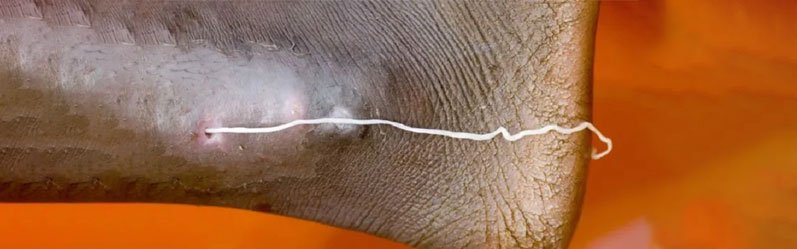
Dracunculiasis, commonly known as Guinea Worm Disease, is a parasitic infection caused by the nematode worm Dracunculus medinensis. It is a neglected tropical disease that has been nearly eradicated through global efforts, with only a few cases reported in recent years, mostly in parts of Africa. The disease is transmitted through drinking contaminated water containing tiny crustaceans (copepods) infected with worm larvae. After about a year, the adult female worm (which can grow up to 1 meter long) emerges slowly through the skin, usually on the lower leg or foot, causing intense pain and disability. In homeopathy, remedies are used only as supportive care to ease pain, reduce inflammation, and support healing during the emergence phase. There is no specific medicine that kills the worm; the standard approach is careful manual extraction. Homeopathy does not replace proper medical management or prevention through safe drinking water.
(Images above show the characteristic painful blister and ulcer of Dracunculiasis with the white Guinea worm emerging from the skin, typically on the lower leg or foot.)
Causes
Dracunculiasis is caused by infection with the Guinea worm Dracunculus medinensis. Humans get infected by drinking stagnant water containing copepods (small water fleas) that carry the worm larvae. The larvae are released in the stomach, penetrate the intestinal wall, and migrate through the body. After about 10–14 months, the mature female worm moves to the skin surface and induces a blister.
Symptoms
Symptoms usually appear about one year after infection when the worm is ready to emerge:
- A painful blister or ulcer on the skin (most often on the lower leg, foot, or ankle)
- Intense burning, itching, and swelling around the blister
- The worm slowly emerges as a thin white filament over several days to weeks
- Secondary bacterial infection of the ulcer is common
- Systemic symptoms may include fever, nausea, vomiting, joint pain, or difficulty breathing due to allergic reaction to worm antigens
- Severe pain and disability that can last weeks, preventing the person from working or walking
Homeopathy Medicines with Key Symptoms and Doses
Homeopathic remedies are chosen according to the individual symptom picture to provide supportive relief from pain, inflammation, and secondary infection during worm emergence. Remedy selection must be determined only by a qualified homeopath after detailed case-taking, in coordination with medical care for worm extraction and infection management. These are general guidelines only. The primary treatment remains slow manual winding of the worm on a stick combined with wound care.
Arsenicum Album For intense burning pain, anxiety, restlessness, and weakness. The person feels chilly but better from warmth and wants small sips of water. Useful for secondary infection with offensive discharge. Typical use: 30C, 3-5 pellets 1-2 times daily during acute distress.
Belladonna Indicated for sudden, throbbing pain with redness, heat, and swelling around the blister. The area is very sensitive to touch. Typical use: 30C, 3-5 pellets 1-2 times daily (short term).
Apis Mellifica For stinging, burning pain with puffy swelling that is relieved by cold applications. The skin looks shiny and red. Typical use: 30C, 3-5 pellets 1-2 times daily.
Rhus Toxicodendron For painful, itchy blisters with restlessness. Symptoms improve with warm applications and continued gentle movement. Typical use: 30C, 3-5 pellets 1-2 times daily.
Mercurius Solubilis For secondary bacterial infection with offensive discharge, swollen glands, and pain worse at night. Excessive salivation may be present. Typical use: 30C, 3-5 pellets 1-2 times daily (short term).
Silicea Helpful in promoting expulsion of foreign bodies or supporting healing in slow-healing ulcers with tendency to suppuration. Typical use: 6X or 30C, 3-5 pellets 1-2 times daily.
Sulphur For intense itching and burning with unhealthy skin tendency. Often used as an intercurrent remedy when other well-selected remedies do not hold. Typical use: 30C or 200C, sparingly (once weekly under guidance).
Hypericum Perforatum For sharp, shooting nerve pain along the path of the worm or in the affected area. Useful when there is tingling or hypersensitivity. Typical use: 30C, 3-5 pellets 1-2 times daily.
Arnica Montana For bruised, sore feeling in the tissues around the emerging worm with general soreness. Typical use: 30C, 3-5 pellets 1-2 times daily (short term).
Calcarea Sulphurica Supports healing of suppurating wounds with thick yellow discharge. Useful in cases with delayed resolution of the ulcer. Typical use: 6X or 30C, 3-5 pellets 1-2 times daily.
Important guidance: The mainstay of treatment for Dracunculiasis is slow, careful extraction of the worm by winding it on a stick over days to weeks, combined with wound cleaning and antibiotics if secondary infection occurs. There is no drug that kills the adult worm. Prevention is achieved through safe drinking water (filtering or boiling) and avoiding contamination of water sources. Dracunculiasis is on the verge of global eradication. Homeopathy may help relieve pain and support healing as supportive care but must not replace proper medical wound management. This information is for educational purposes only and not a substitute for professional medical or homeopathic advice. Consult a qualified doctor immediately for any suspected case, and a registered homeopath for individualized supportive remedy selection. Continued global efforts have made this once-common disease extremely rare.