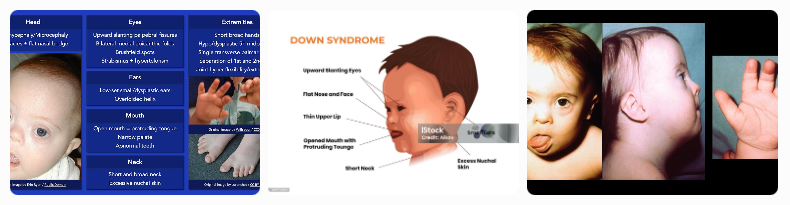
Down Syndrome (also called Trisomy 21) is a genetic condition caused by the presence of an extra copy of chromosome 21. It leads to certain physical features, developmental delays, and increased risk of some health problems. Every child with Down syndrome is unique — some have mild symptoms while others need more support. There is no cure for Down syndrome because it is a genetic condition present from birth. In homeopathy, remedies are selected to support the child’s overall development, immunity, learning ability, and associated symptoms in a gentle, individualized way. Homeopathy works as supportive care only and must be used along with regular medical check-ups, early intervention therapies (speech, occupational, physiotherapy), and special education.


(Images above show typical physical features of Down syndrome such as flat facial profile, upward slanting eyes, small ears, protruding tongue, short neck, single palmar crease, and sandal gap between toes.)
Causes
Down syndrome is caused by:
- An extra full or partial copy of chromosome 21 (Trisomy 21) — usually due to random error during cell division in the egg or sperm.
- Advanced maternal age increases the risk.
- In rare cases, it can be inherited (translocation type).
It is not caused by anything the parents did or did not do during pregnancy.
Symptoms
Common features and symptoms include:
- Distinct facial features: flat face, upward slanting eyes, small ears, flat nasal bridge
- Low muscle tone (hypotonia) — baby feels floppy
- Short neck with extra skin at the back
- Single crease across the palm (simian crease) and wide space between big and second toe
- Delayed milestones — slow to sit, crawl, walk, and speak
- Intellectual disability ranging from mild to moderate
- Increased risk of heart defects, thyroid problems, hearing and vision issues, and frequent infections
Homeopathy Medicines with Key Symptoms and Doses
Homeopathic remedies for Down syndrome are chosen according to the child’s individual constitution, developmental pattern, and associated complaints. They aim to improve vitality, immunity, muscle tone, and cognitive support. Remedy selection must be done only by a qualified and experienced homeopath (preferably one familiar with pediatric developmental cases) after detailed case-taking. These are general guidelines only. Homeopathy is used as complementary support along with conventional medical care.
Baryta Carbonica Indicated for children with delayed physical and mental development, slow learning, shyness, and enlarged tonsils or glands. The child may appear timid and physically underdeveloped. Typical use: 30C or 200C, 3-5 pellets once or twice weekly (sparingly).
Calcarea Carbonica Suited to fair, chubby, sweaty children with delayed milestones, large head, and tendency to catch colds easily. Supports constitutional weakness and slow bone development. Typical use: 30C or 200C, 3-5 pellets once or twice weekly.
Silicea Helpful in delicate, chilly children with poor assimilation, recurrent infections, and slow healing. Promotes vitality and supports nervous system development. Typical use: 6X or 30C, 3-5 pellets 1-2 times daily (monitor closely).
Natrum Muriaticum For emotionally reserved children who crave salt and have dryness of skin or mucous membranes. May support cases with learning difficulties linked to emotional factors. Typical use: 30C, 3-5 pellets 1-2 times daily.
Medorrhinum A nosode sometimes used in children with developmental delays, especially when there is a family history of chronic ailments or when well-selected remedies do not hold. Typical use: 200C or higher, single dose or very sparingly (under strict guidance).
Phosphorus Useful for open, affectionate children who are sensitive, fearful, and have bleeding tendencies or weak lungs. Supports vitality in thin, tall children with learning issues. Typical use: 30C, 3-5 pellets 1-2 times daily (use cautiously).
Thuja Occidentalis Indicated when there is a history of vaccinations or tendency to wart-like growths, along with developmental sluggishness. Supports immunity. Typical use: 30C, 3-5 pellets 1-2 times daily (short courses).
Agaricus Muscarius For children with twitching, jerking, or clumsy movements and delayed milestones. Useful when there is neurological involvement. Typical use: 30C, 3-5 pellets 1-2 times daily.
Calcarea Phosphorica Supports bone and teeth development in children with slow growth and delayed milestones. Good for weak, anemic children. Typical use: 6X or 30C, 3-5 pellets 1-2 times daily.
Lycopodium Clavatum For children with digestive weakness, bloating, lack of confidence, and right-sided complaints. Helps in cases with learning difficulties and anticipatory anxiety. Typical use: 30C or 200C, 3-5 pellets 1-2 times daily.
Important guidance: Children with Down syndrome benefit greatly from early intervention — regular screening for heart, thyroid, hearing, vision, and developmental therapies. Homeopathy may offer constitutional support to improve overall health and development but cannot change the genetic condition. This information is for educational purposes only and not a substitute for professional medical or homeopathic advice. Always consult a qualified pediatrician/genetic specialist for medical management and a registered, experienced homeopath for individualized remedy selection. With proper care and support, many children with Down syndrome lead happy, fulfilling lives.