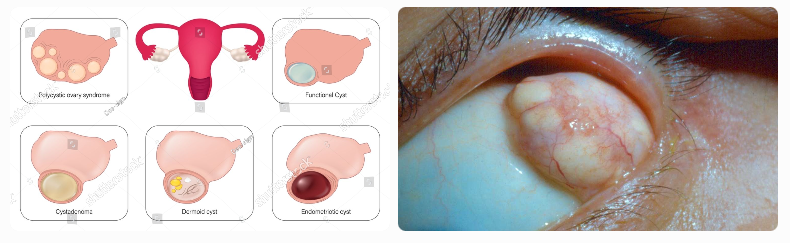
Dermoid Cyst is a benign (non-cancerous) congenital cyst that forms when skin cells and other tissues (such as hair, teeth, fat, or sebaceous material) become trapped during fetal development. It can occur anywhere along the lines of embryonic fusion, most commonly on the face (near the eyebrow or scalp), in the ovaries (mature cystic teratoma), or rarely in the spine or other areas. These cysts grow slowly and are usually harmless, but they can cause problems if they enlarge, become infected, or rupture. In homeopathy, remedies are used only as supportive care to help reduce inflammation, discomfort, or associated symptoms. Surgical removal is the standard and definitive treatment for symptomatic or large dermoid cysts.

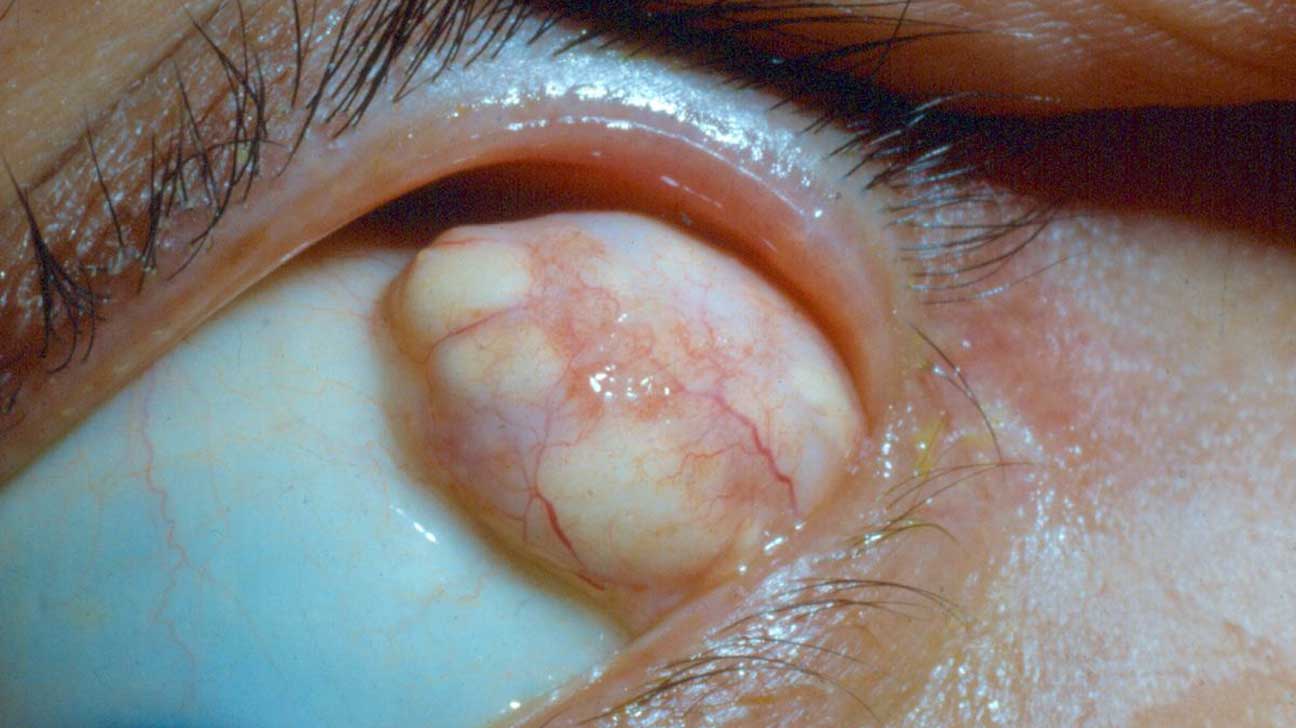
(Images above show dermoid cysts — typical ovarian dermoid with mixed tissues inside and a periorbital dermoid cyst near the eye.)
Causes
Dermoid cysts are congenital, meaning they develop during early fetal life when ectodermal tissue (skin and its appendages) gets trapped along embryonic fusion lines. The exact reason is not fully understood, but they are not caused by injury or infection after birth. Ovarian dermoid cysts are the most common type in adults.
Symptoms
Many dermoid cysts cause no symptoms and are discovered incidentally. When symptoms appear, they depend on the location and size:
- A painless, firm, smooth lump under the skin (often on the face or scalp)
- In ovaries: pelvic pain, bloating, or pressure if large
- If infected or ruptured: sudden pain, redness, swelling, or fever
- Rarely: pressure on nearby structures causing vision issues (near eye) or neurological symptoms (spinal)
Homeopathy Medicines with Key Symptoms and Doses
Homeopathic remedies for dermoid cyst are selected based on the individual’s constitution, location of the cyst, and associated symptoms. They may offer supportive relief from discomfort or inflammation but cannot dissolve or replace the need for surgical removal of the cyst. The following are sometimes considered. Remedy selection must be determined only by a qualified homeopath after detailed case-taking, in close coordination with a surgeon or gynecologist. These are general guidelines only.
Silicea Useful for slow-growing cysts with tendency to suppuration or recurrent low-grade infection. Supports tissue strength and may help in chronic cases. Typical use: 6X or 30C, 3-5 pellets 1-2 times daily.
Calcarea Fluorica Indicated for hard, fibrous, or glandular swellings and cystic formations. Helps improve elasticity of tissues. Typical use: 6X or 30C, 3-5 pellets 1-2 times daily.
Thuja Occidentalis For cystic or warty growths, especially with a history of vaccinations or skin tendencies. Supports resolution of abnormal tissue growths. Typical use: 30C, 3-5 pellets 1-2 times daily (short courses).
Graphites Suited when there is sticky or honey-like discharge, rough/dry skin, or cracking around the area. Typical use: 30C, 3-5 pellets 1-2 times daily.
Hepar Sulphuris For painful or inflamed cysts with extreme sensitivity to touch and risk of infection. Typical use: 30C, 3-5 pellets 1-2 times daily (short term).
Apis Mellifica For swollen, stinging or burning cysts with puffy appearance, better from cold applications. Typical use: 30C, 3-5 pellets 1-2 times daily.
Lachesis Muta For left-sided cysts with bluish discoloration or extreme sensitivity. Symptoms may worsen after sleep. Typical use: 30C, 3-5 pellets 1-2 times daily (under guidance).
Calcarea Carbonica For fair, sweaty persons with constitutional sluggishness and tendency to cystic swellings. Typical use: 30C or 200C, 3-5 pellets once or twice weekly.
Arsenicum Album For burning pain with anxiety and restlessness in chronic or painful cases. Typical use: 30C, 3-5 pellets 1-2 times daily (short term).
Sulphur Often used as an intercurrent remedy in chronic skin or cystic tendencies with burning and heat aggravation. Typical use: 30C or 200C, sparingly (once weekly under guidance).
Important guidance: Most dermoid cysts are diagnosed by ultrasound, CT, or MRI and are best treated by complete surgical removal to prevent complications like infection, rupture, or (rarely) malignant change in ovarian dermoids. Homeopathy may help manage associated discomfort or inflammation as supportive care but cannot replace surgery or medical monitoring. Do not attempt to squeeze or drain the cyst yourself. This information is for educational purposes only and not a substitute for professional medical or homeopathic advice. Consult a qualified surgeon or gynecologist immediately for proper diagnosis and treatment (especially for ovarian or symptomatic cysts), and a registered homeopath for individualized supportive remedy selection. Early evaluation ensures the best outcome.