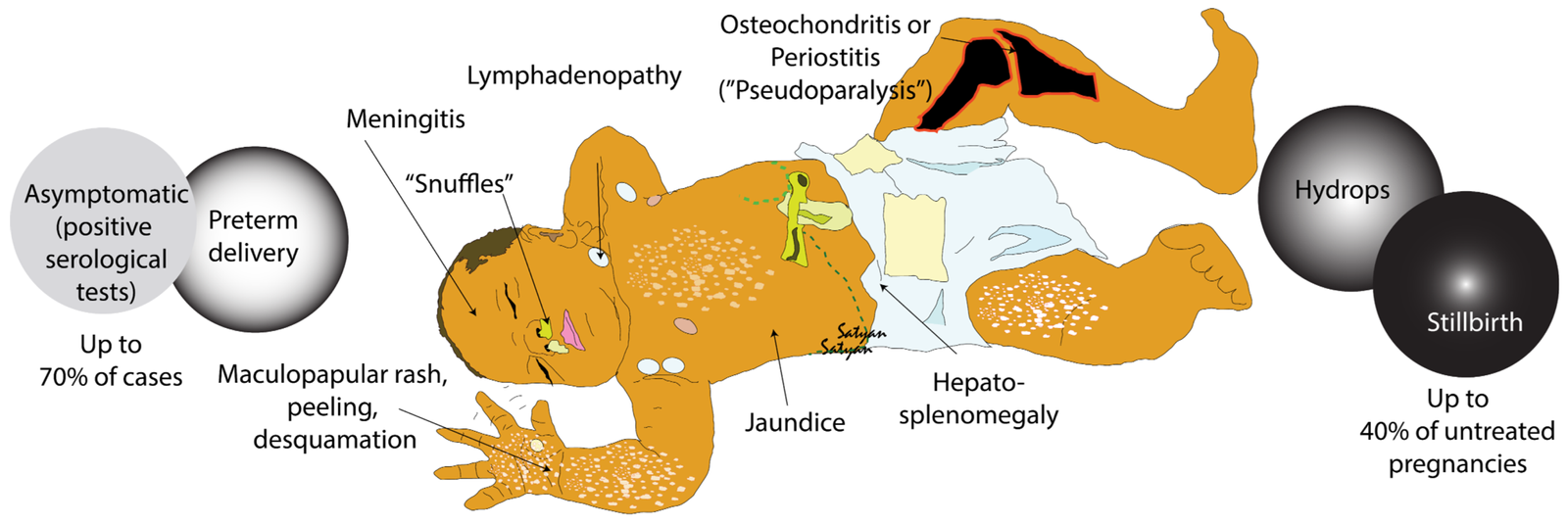
Congenital Syphilis is a serious infection that occurs when the bacterium Treponema pallidum (the cause of syphilis) is transmitted from an infected mother to her fetus during pregnancy or, rarely, during childbirth. It can lead to miscarriage, stillbirth, or a wide range of lifelong health problems in the newborn if untreated. With timely maternal treatment during pregnancy, most cases can be prevented. In homeopathy, remedies are selected based on the child’s constitutional picture, specific manifestations (skin, bone, eye, or neurological involvement), and miasmatic background (syphilitic miasm). Homeopathy may offer supportive care to improve vitality and manage certain residual symptoms, but it is not a substitute for standard medical treatment. The primary treatment is penicillin (usually intravenous aqueous crystalline penicillin G for 10 days in newborns). Early detection through prenatal screening and prompt antibiotic therapy is essential to prevent severe outcomes.
(Images above illustrate characteristic features of congenital syphilis, including the "blueberry muffin" rash, snuffles (rhinitis), saddle nose deformity, Hutchinson’s teeth, and interstitial keratitis, along with comparison to normal features.)
Causes
Congenital syphilis is caused by transplacental transmission of Treponema pallidum from a mother with untreated or inadequately treated syphilis to the fetus. The risk is highest during primary or secondary maternal syphilis and in the first half of pregnancy. Key factors include:
- Untreated maternal syphilis (especially early stages)
- Lack of prenatal screening or treatment
- Late or inadequate maternal penicillin therapy
- Rarely, transmission during delivery through contact with genital lesions
Symptoms
Manifestations are divided into early (birth to 2 years) and late (after 2 years):
Early congenital syphilis (often apparent at birth or within first few months):
- "Snuffles" (persistent runny nose with blood-stained discharge)
- Skin rash (maculopapular or bullous, often on palms and soles; "blueberry muffin" spots)
- Hepatosplenomegaly (enlarged liver and spleen), jaundice, anemia
- Bone involvement (osteochondritis, periostitis causing painful limbs and pseudoparalysis)
- Failure to thrive, fever, swollen lymph nodes
Late congenital syphilis (Hutchinson’s triad and others):
- Hutchinson’s teeth (peg-shaped, notched upper central incisors)
- Interstitial keratitis (eye inflammation leading to vision problems)
- Sensorineural deafness (eighth nerve)
- Saddle nose deformity, high-arched palate, frontal bossing
- Clutton’s joints, saber shins, mulberry molars, rhagades (scars around mouth)
Many infants may be asymptomatic at birth but develop symptoms later if untreated.
Homeopathy Medicines with Key Symptoms and Doses
Homeopathic remedies for congenital syphilis are chosen according to the child’s full symptom totality and syphilitic miasmatic background. They are used supportively alongside mandatory conventional penicillin therapy and specialist care (pediatric infectious disease, ENT, ophthalmology). The following are among the remedies classically considered in homeopathic literature for syphilitic or hereditary conditions. Remedy selection, potency, and repetition must be determined only by a qualified homeopath experienced in pediatric cases after thorough case-taking, in close coordination with medical specialists. These are general guidelines only.
Syphilinum (Luesinum) The nosode of syphilis, indicated for deep-seated, destructive, or hereditary syphilitic manifestations. Useful in chronic cases with bone pains worse at night, ulceration, or when well-selected remedies fail. Symptoms often have a nocturnal aggravation and destructive tendency. Typical use: 200C or higher, single dose or very sparingly (once weekly or monthly under strict guidance).
Mercurius Solubilis One of the leading remedies for syphilitic conditions with offensive discharges, swollen glands, excessive salivation, and ulceration. Useful in early congenital cases with snuffles, skin eruptions, or mucous membrane involvement; worse at night and from temperature changes. Typical use: 30C, 3-5 pellets 1-2 times daily (short term, under supervision).
Aurum Metallicum Indicated for syphilitic bone involvement, especially destruction of nasal bones (saddle nose), deep bone pains worse at night, and depression or suicidal tendencies in older children. Suits cases with profound constitutional effects. Typical use: 30C or 200C, 3-5 pellets sparingly (once or twice weekly).
Kali Iodatum Helpful for syphilitic bone pains, periostitis, and nasal involvement with profuse, watery, acrid discharge. Pain worse at night; useful in cases with glandular swelling or skin eruptions. Typical use: 30C, 3-5 pellets 1-2 times daily.
Nitric Acid For painful ulcers or fissures with splinter-like pains, irregular edges, and easy bleeding. Offensive discharge; worse from cold or touch; useful in mucous membrane or skin lesions of syphilitic origin. Typical use: 30C, 3-5 pellets 1-2 times daily.
Fluoric Acid Indicated for deep, destructive ulcers or bone caries with burning pains. Symptoms better from cold applications; useful in chronic syphilitic bone or skin destruction. Typical use: 30C, 3-5 pellets 1-2 times daily.
Stillingia Silvatica For syphilitic bone pains, especially long bones, with periosteal involvement and skin eruptions. Pain worse at night; useful in secondary or tertiary-like manifestations. Typical use: 30C, 3-5 pellets 1-2 times daily.
Aurum Muriaticum For syphilitic conditions with glandular involvement, nasal bone destruction, and emotional symptoms. Often indicated after abuse of mercury or in chronic destructive phases. Typical use: 30C, 3-5 pellets 1-2 times daily.
Important guidance: Congenital syphilis is a medical emergency. Standard treatment is penicillin (aqueous crystalline penicillin G IV for 10 days in newborns). Homeopathy may provide constitutional and supportive care for residual symptoms or vitality but cannot replace antibiotics. All pregnant women should be screened and treated to prevent transmission. Affected children need long-term follow-up for hearing, vision, dental, and developmental issues. This information is for educational purposes only and not a substitute for professional medical or homeopathic advice. Always consult a qualified pediatric infectious disease specialist for diagnosis and treatment, and a registered homeopath experienced in pediatric cases for individualized remedy selection. Prevention through maternal screening and treatment is the best approach.