Congenital Deafness (also called congenital hearing loss) is a condition in which a baby is born with partial or complete inability to hear in one or both ears. It is one of the most common birth defects, affecting approximately 1–3 per 1,000 newborns. It can be sensorineural (damage to the inner ear or auditory nerve), conductive (problems in the outer or middle ear), or mixed. Early detection through newborn hearing screening is critical because untreated congenital deafness can severely impact speech, language development, learning, and social skills. In homeopathy, remedies are selected based on the child’s constitution, associated symptoms, family history, and any accompanying features (e.g., developmental delays or infections). Homeopathy aims to support overall vitality and nervous system function, but it cannot restore hearing in cases of structural malformations or severe sensorineural damage. It is used only as a complementary supportive measure. Prompt medical evaluation by a pediatric ENT specialist or audiologist is essential, often involving hearing aids, cochlear implants, speech therapy, and early intervention programs.
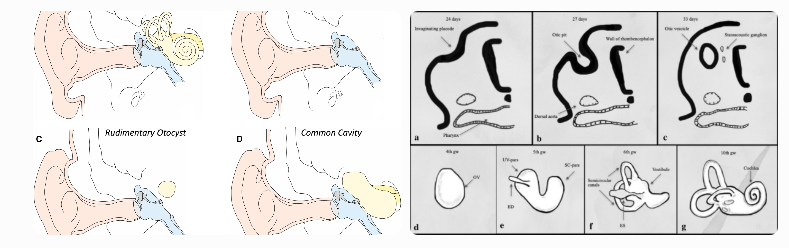
(Images above illustrate normal inner ear structures versus common congenital malformations such as labyrinthine aplasia, rudimentary otocyst, and common cavity deformity that can cause congenital deafness.)
Causes
Congenital deafness may be genetic (hereditary) or non-genetic:
- Genetic causes — Mutations in genes affecting inner ear development (non-syndromic or syndromic, e.g., Usher syndrome, Waardenburg syndrome, Pendred syndrome).
- Intrauterine infections — TORCH infections (Toxoplasmosis, Rubella, Cytomegalovirus, Herpes).
- Maternal factors — Diabetes, medications, alcohol, smoking, or exposure to ototoxic drugs during pregnancy.
- Structural malformations — Inner ear anomalies (cochlear aplasia, enlarged vestibular aqueduct, etc.).
- Perinatal factors — Prematurity, low birth weight, birth asphyxia, or severe jaundice (kernicterus).
- Other — Chromosomal abnormalities (e.g., Down syndrome).
Symptoms
In infants, symptoms are often noticed during newborn screening or later developmental milestones:
- Failure to respond to loud sounds or voice (no startle reflex)
- Lack of babbling or delayed speech development
- Not turning toward sounds by 3–6 months
- In older children: speech delay, poor language skills, behavioral issues, or academic difficulties
- Associated signs: abnormal head shape/ear structure, balance problems, or syndromic features (e.g., white forelock in Waardenburg syndrome)
Unilateral deafness may remain unnoticed longer than bilateral cases.
Homeopathy Medicines with Key Symptoms and Doses
Homeopathic remedies for congenital deafness are selected according to the child’s full symptom picture and constitutional type. Results vary greatly and are generally supportive rather than curative for structural causes. The following remedies are sometimes considered in classical homeopathic literature for deafness or related ear conditions. Remedy selection, potency, and repetition must be determined only by a qualified homeopath experienced in pediatric cases after thorough case-taking and in coordination with medical specialists. These are general guidelines only.
Baryta Carbonica Indicated for children with delayed development, slow learning, and hearing difficulties. The child appears physically and mentally underdeveloped; enlarged tonsils or recurrent infections may be present. Useful in cases with constitutional sluggishness. Typical use: 30C or 200C, 3-5 pellets once or twice weekly (sparingly in children).
Silicea Helpful in delicate, chilly children with slow healing and tendency to recurrent ear infections or suppuration leading to hearing issues. Splinter-like sensations or sensitivity to cold; promotes expulsion and vitality. Typical use: 6X or 30C, 3-5 pellets 1-2 times daily (monitor closely).
Calcarea Carbonica Suited to fair, plump children with sweaty head, delayed milestones, and tendency to catch colds easily. Hearing issues with constitutional weakness; fear of cold and damp. Typical use: 30C or 200C, 3-5 pellets once or twice weekly.
Mercurius Solubilis For cases with chronic ear discharge, offensive secretions, and hearing loss. Swollen glands, excessive salivation, and worsening at night or with temperature changes. Typical use: 30C, 3-5 pellets 1-2 times daily (short term).
Pulsatilla Nigricans Indicated when hearing difficulty follows recurrent colds with thick, bland discharge. Mild, weepy child who craves open air and consolation; symptoms changeable. Typical use: 30C, 3-5 pellets 1-2 times daily.
Causticum For stiffness, weakness, or paralytic feeling in ear-related nerves with hearing loss. Symptoms worse from cold dry air; useful in progressive or contracture-like cases. Typical use: 30C, 3-5 pellets 1-2 times daily.
Graphites For thick, sticky ear discharge with cracking sounds and dry, cracked skin. Suits constipated children with unhealthy skin tendency. Typical use: 30C, 3-5 pellets 1-2 times daily.
Natrum Muriaticum For emotionally reserved children with history of grief or suppression; dryness or mapped tongue may accompany hearing issues. Craving for salt. Typical use: 30C, 3-5 pellets 1-2 times daily.
Important guidance: Congenital deafness is primarily managed with early hearing amplification (hearing aids), cochlear implants (in severe sensorineural cases), speech-language therapy, and sign language support. Homeopathy may offer supportive care for associated symptoms or constitutional improvement but has limited evidence for reversing structural or genetic hearing loss. Regular audiological monitoring and early intervention programs are crucial for optimal language development. Avoid self-medication in infants and children. This information is for educational purposes only and not a substitute for professional medical or homeopathic advice. Always consult a qualified pediatric ENT specialist/audiologist for diagnosis and management, and a registered homeopath experienced in pediatric cases for individualized remedy selection. Early detection and intervention significantly improve outcomes.