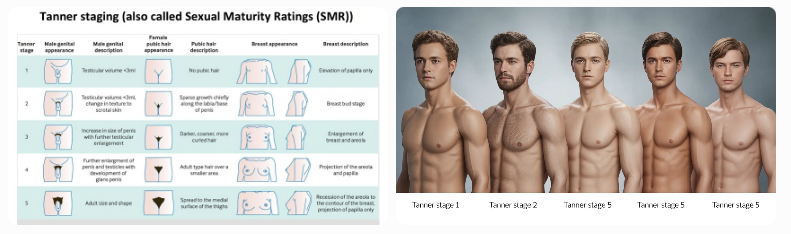
Delayed Puberty is a condition in which a child does not develop secondary sexual characteristics at the expected age. In girls, it is defined as no breast development by age 13 or no menstrual periods by age 16. In boys, it is no testicular enlargement by age 14. Many children with delayed puberty are otherwise healthy and eventually catch up (constitutional delay), but it can also result from underlying hormonal, nutritional, or medical issues. In homeopathy, remedies are used only as supportive care to stimulate natural development, improve vitality, and support hormonal balance. Delayed puberty requires proper medical evaluation by a pediatric endocrinologist to rule out serious causes.
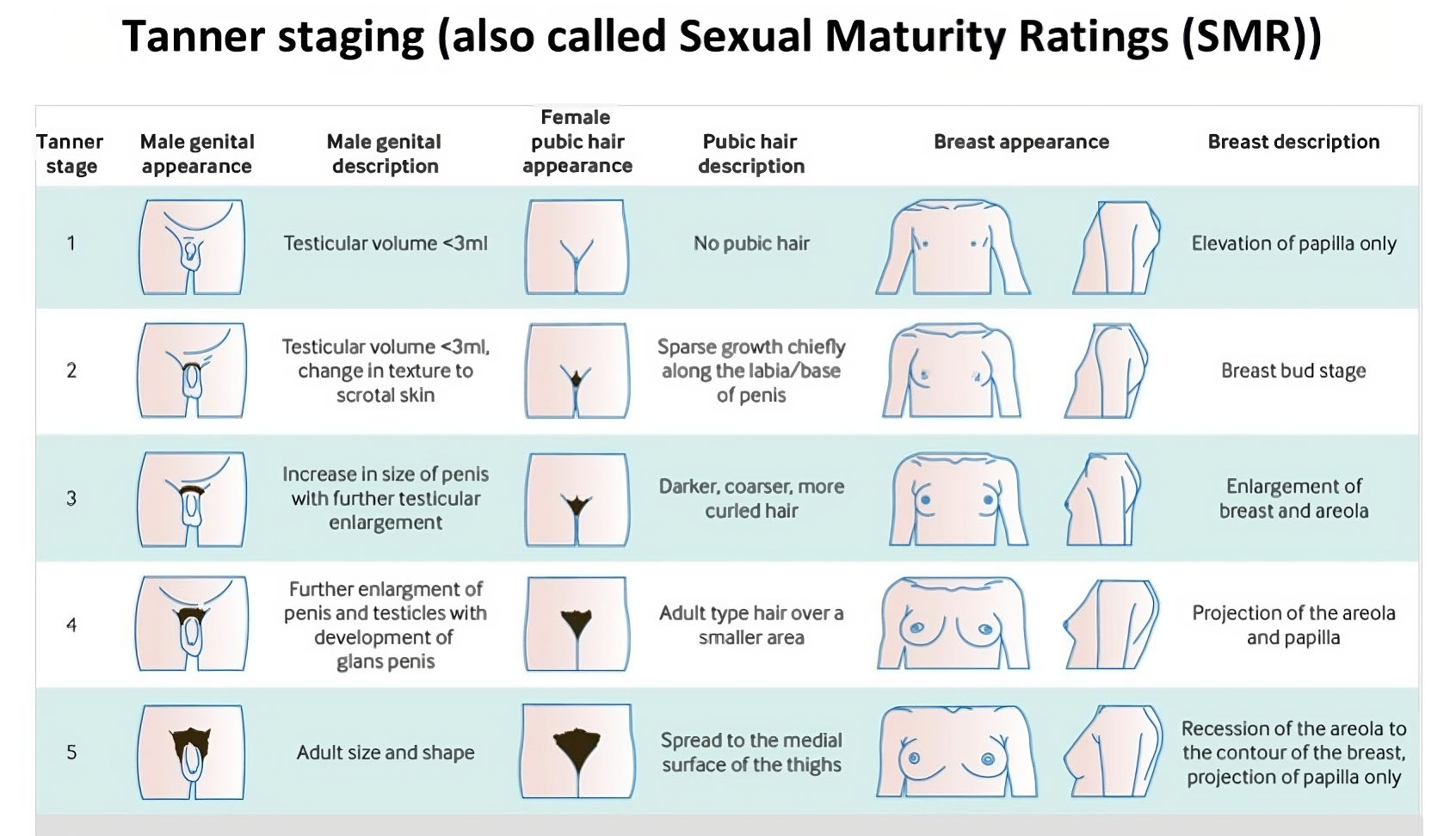

(Images above illustrate Tanner staging — comparison between normal puberty progression and delayed puberty with absent or minimal secondary sexual characteristics.)
Causes
Common causes of delayed puberty include:
- Constitutional delay of growth and puberty (most common, often runs in families)
- Hormonal deficiencies (growth hormone, thyroid hormone, or hypogonadism)
- Chronic illnesses (celiac disease, kidney disease, inflammatory bowel disease, or malnutrition)
- Excessive exercise, low body weight, or eating disorders
- Genetic conditions (Turner syndrome in girls, Klinefelter syndrome in boys)
Symptoms
Typical signs include:
- Absence of breast development or pubic hair in girls by age 13
- No testicular enlargement or voice deepening in boys by age 14
- Short stature or slower growth compared to peers
- Delayed bone age on X-ray
- Emotional distress, low self-esteem, or social withdrawal due to appearing younger than peers
- In some cases: lack of menstrual periods (in girls) or poor muscle development
Homeopathy Medicines with Key Symptoms and Doses
Homeopathic remedies for delayed puberty are highly constitutional and aim to support natural hormonal balance and overall development. The following are commonly considered for supportive management. Remedy selection must be determined only by a qualified homeopath experienced in pediatric endocrinology after detailed case-taking, in coordination with a pediatric endocrinologist. These are general guidelines only. Regular monitoring of growth and hormone levels is essential.
Baryta Carbonica Indicated for children with delayed physical and sexual development, slow learning, and timid nature. The child appears younger than actual age with enlarged glands. Typical use: 30C or 200C, 3-5 pellets once or twice weekly (sparingly).
Calcarea Carbonica Suited to fair, chubby, sweaty children with delayed milestones and slow puberty. Supports constitutional weakness and poor assimilation. Typical use: 30C or 200C, 3-5 pellets once or twice weekly.
Silicea Helpful for delicate, chilly children with poor nutrient absorption, recurrent infections, and delayed development including puberty. Typical use: 6X or 30C, 3-5 pellets 1-2 times daily (monitor closely).
Calcarea Phosphorica Useful for slow bone growth, delayed dentition, and delayed puberty with growing pains and weakness. Supports calcium-phosphorus metabolism. Typical use: 6X or 30C, 3-5 pellets 1-2 times daily.
Natrum Muriaticum For emotionally reserved children with growth and puberty delay linked to grief or emotional suppression. Typical use: 30C, 3-5 pellets 1-2 times daily.
Lycopodium Clavatum For children with digestive weakness, bloating, lack of confidence, and delayed puberty. Symptoms often worse in the late afternoon. Typical use: 30C or 200C, 3-5 pellets 1-2 times daily.
Pulsatilla Nigricans For mild, changeable symptoms in gentle, emotional children. Delayed puberty with weeping tendency and desire for open air. Typical use: 30C, 3-5 pellets 1-2 times daily.
Phosphorus For tall, thin, open children with weak vitality and delayed development affecting puberty. Typical use: 30C, 3-5 pellets 1-2 times daily (use cautiously).
Sepia Officinalis Especially useful in girls with delayed or irregular puberty, hormonal imbalance, and fatigue. The girl may feel indifferent or irritable. Typical use: 30C, 3-5 pellets 1-2 times daily (under guidance).
Aurum Metallicum For delayed puberty with low mood, self-doubt, and history of vascular or heart-related issues. Typical use: 30C or 200C, sparingly (once or twice weekly).
Important guidance: Delayed puberty needs complete medical assessment including bone age X-ray, hormone tests (FSH, LH, testosterone/estrogen), and sometimes MRI or genetic testing. Treatment may involve watchful waiting, nutritional support, or hormone replacement in specific cases. Homeopathy may help support natural development and vitality as supportive care but cannot replace proper endocrine evaluation and management. Focus on balanced nutrition, adequate sleep, reduced stress, and regular physical activity. Emotional support is very important as delayed puberty can affect self-esteem. This information is for educational purposes only and not a substitute for professional medical or homeopathic advice. Consult a qualified pediatric endocrinologist immediately for accurate diagnosis and management, and a registered homeopath experienced in pediatric growth disorders for individualized supportive remedy selection. With timely care, most children achieve normal puberty and growth.